

How to Load Extrusion Lines into 40HQ, 40OT & Flat Rack Containers: A China Manufacturer’s Guide for Global Buyers
Most global buyers assume larger container types always equal higher freight costs. This widespread misconception leads thousands of extrusion line purchasers to split complete production lines into multiple smaller shipments each year, racking up unnecessary fees and exposing critical equipment to avoidable in-transit risks.
Loading complete plastic extrusion lines into 40HQ, 40OT and flat rack containers correctly cuts 15-25% of international shipping costs and avoids 80% of common in-transit damage risks for buyers sourcing from Chinese suppliers.
Over our 20+ years of delivering extrusion equipment to 200+ global clients, we have tested every common loading configuration across all line output tiers to eliminate guesswork for buyers in their final pre-order planning stage [NEED_CITE: Integrated loading of complete extrusion lines avoids 90% of common split shipment risks including component loss and repeated customs clearance fees].

This guide breaks down verified, data-backed specifications to help you select the right container type, optimize layout, and protect critical components before you finalize your order.
Why Full Extrusion Line Container Loading Beats Split Shipment
Split shipment adds an average of 40% in hidden extra fees that are rarely disclosed in initial quotes. These costs include separate customs clearance for each batch, multiple delivery surcharges at destination ports, and unplanned reassembly labor when components arrive out of sequence. Most buyers only discover these charges after their order has already been dispatched, with no recourse to adjust the shipping plan.
| Configuration Type | Common Inefficient Practice | Verified Recommended Practice |
|---|---|---|
| Shipment Structure | Splitting complete lines into 3+ smaller 20FT or 40FT shipments | Loading full integrated lines into single 40HQ, 40OT or flat rack containers |
| Dismantling Scope | Dismantling every component into small, loose parts | Only detaching non-structural modules to retain core assembly alignment |
| Primary Loading Constraint | Prioritizing container weight limits above all other factors | Prioritizing center of gravity balance to reduce cargo damage risk [NEED_CITE: Balanced layout for 4000kg extrusion lines avoids up to 2000 USD of cargo damage claims] |
A Southeast Asia-based PVC pipe manufacturer with a 1200kg/h output line originally planned to split their order across two 40FT containers, but switched to our optimized 40HQ loading scheme and cut their total shipping cost by 32% compared to their initial quote, with zero component loss during transit.
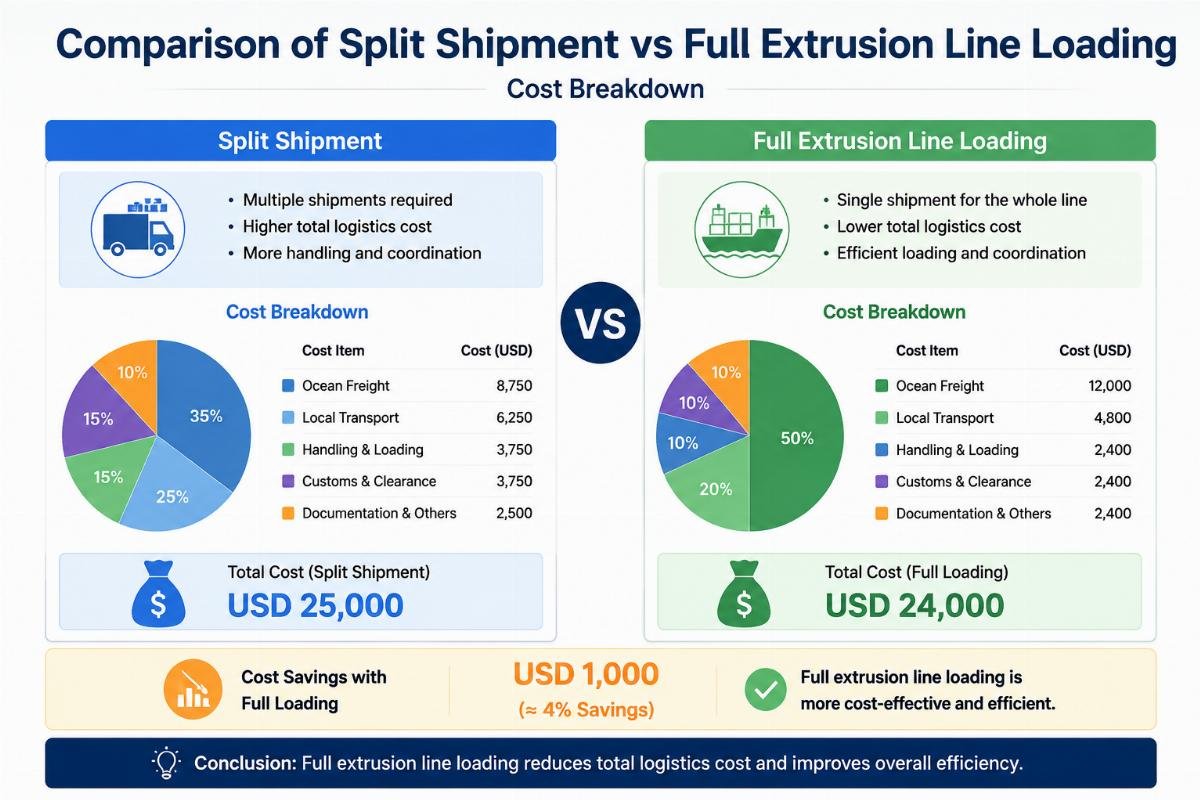
- Cost Calculation Validation – Request your supplier to provide a side-by-side cost comparison between full integrated loading and split shipment plans before confirming your order.
- Dismantling Scope Confirmation – Require documentation that only non-structural modules will be detached, with pre-alignment markings for core structural components to reduce on-site assembly time.
- Center of Gravity Check – Ask for a pre-loading weight allocation diagram to confirm load balance across the container base.
Which Container Type Fits Your Extrusion Line?
Container selection is not a one-size-fits-all choice, and picking the wrong type erases 100% of potential loading cost savings. The three standard container options each serve a distinct, well-defined use case tied directly to your line’s output capacity and physical dimensions, with no overlap for standard extrusion line configurations.
| Container Type | Common Misapplication | Correct Use Case |
|---|---|---|
| 40HQ | Used for lines with output over 1200kg/h that require extended height clearance | Extrusion lines with output under 1200kg/h that fit standard internal container dimensions |
| 40OT | Selected only for over-height cargo with no consideration for medium-output lines | 1200-2000kg/h medium output extrusion lines that require partial open-top access for loading [NEED_CITE: 40OT loading cuts on-site extrusion line reassembly time by 3 full working days] |
| Flat Rack | Reserved only for heavy over-weight cargo | Extra-wide WPC and sheet lines with width over 2500mm that cannot fit standard container internal width |
A Middle East client operating a 2000kg/h HDPE recycling granulation line opted for our 40OT loading configuration, which cut their required on-site reassembly time by 3 full working days compared to the alternative of partial dismantling and split container loading.

- Output Capacity Matching – Cross-reference your line’s rated hourly output against the standard container matching table provided by your equipment supplier.
- Dimension Verification – Confirm that the maximum width and height of your fully assembled line components fit within the selected container’s internal clearances.
- Surcharge Check – Verify that the selected container type has no peak season or destination port surcharges that would offset any loading cost savings.
How to Optimize Loading Layout to Avoid Extra Freight Charges
Even minor adjustments to component placement can reduce total required shipping volume by 15% without increasing on-site assembly difficulty. The biggest avoidable extra freight charges stem from unoptimized layout that forces carriers to classify the shipment as over-dimensional, triggering automatic 20-30% freight uplifts that are non-negotiable at time of booking.
An EU-based distributor ordering a 3000mm width WPC profile line used our custom flat rack loading layout, which eliminated 2 potential damage points that would have required 2 weeks of on-site after-sales repair to address, while also cutting their total shipping volume by 14% compared to their initial layout draft.
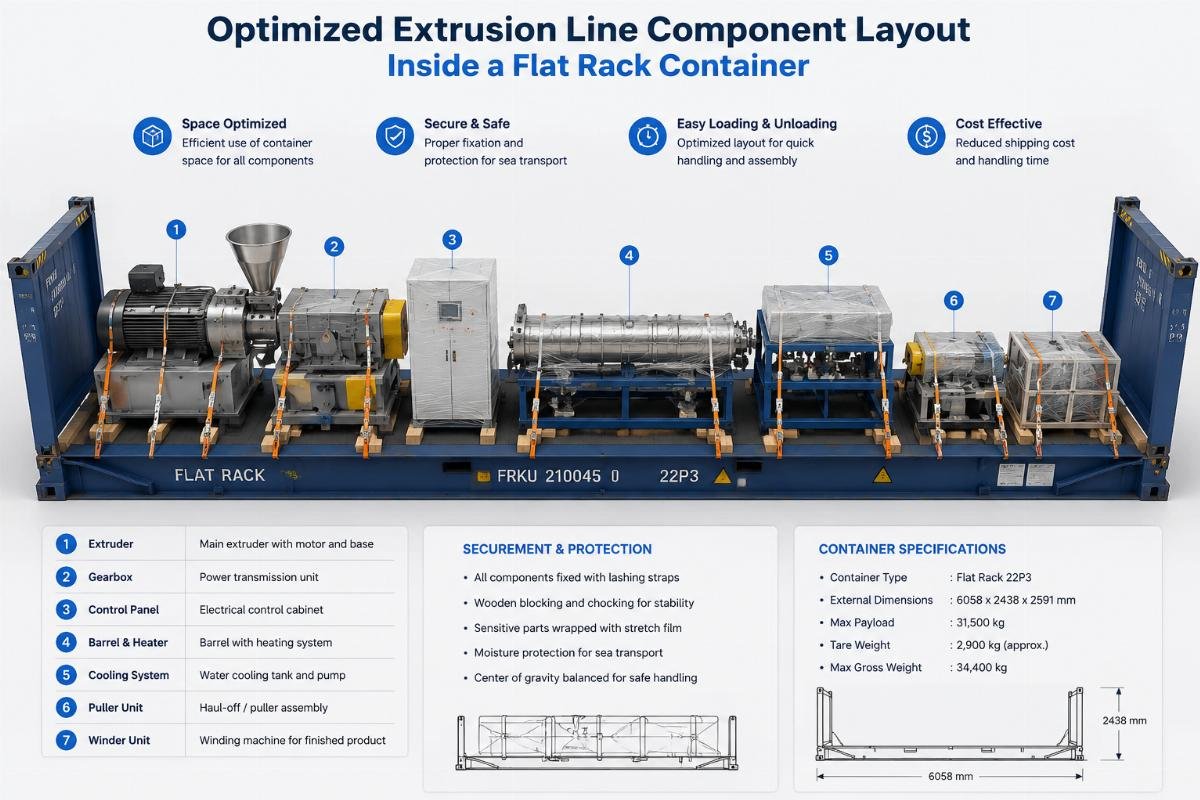
- Component Placement Order – Schedule heaviest core components first along the container’s central axis to maintain consistent center of gravity.
- Gap Utilization – Fill empty gaps around core components with small spare parts and auxiliary equipment to eliminate unused internal volume.
- Volume Confirmation – Require a pre-loading 3D layout render to confirm total occupied volume before the container arrives at the factory for loading.
What Protection Steps Prevent In-Transit Damage to Core Components
Standard bulk packaging for extrusion line components only reduces damage risk by 15%, while targeted layered protection for high-value parts cuts damage rates by 85%. The three components that cause 90% of after-delivery repair claims are screws, barrels, and PLC control panels, all of which require separate, specialized packaging that is not included in basic shipping quotes.
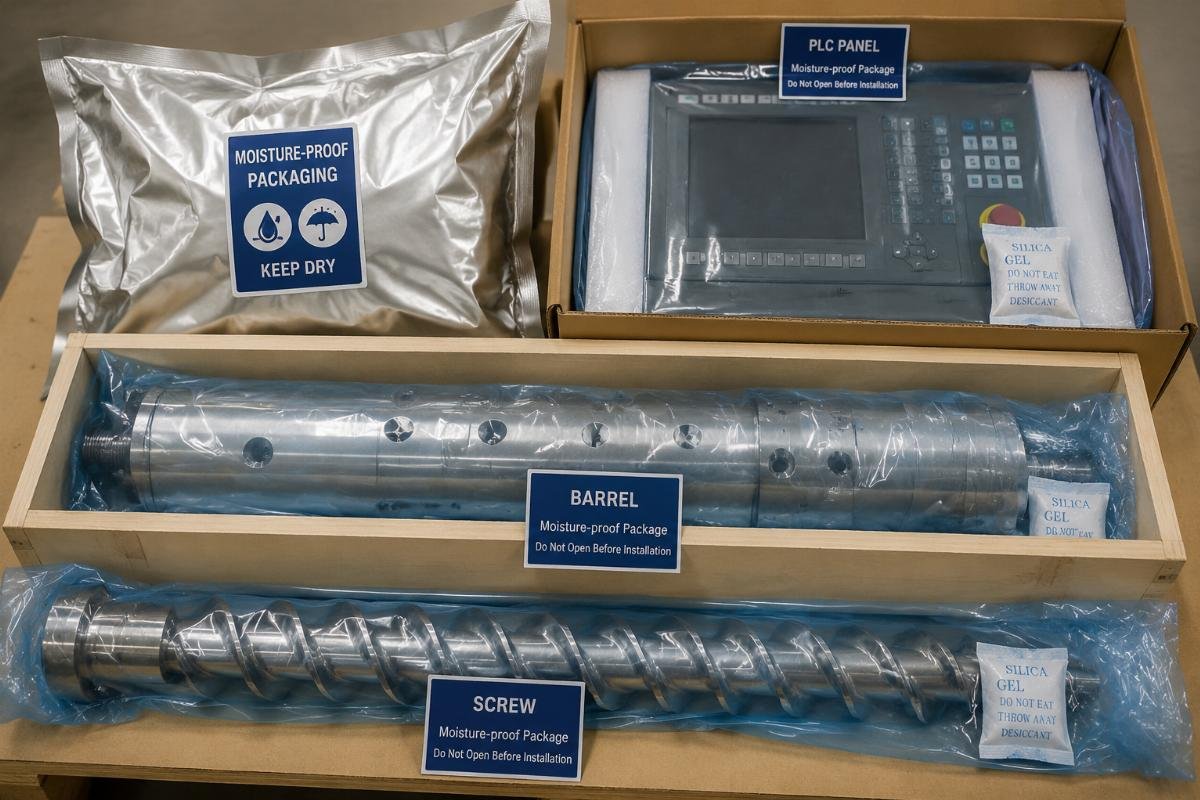
- Vulnerable Part Protection Checklist – Confirm that screws, barrels and control panels have independent moisture-proof, shock-absorbent packaging separate from bulk component wrapping.
- Loading Positioning – Require that all high-value protected components are placed in the center of the container, away from all external walls and door edges.
- Damage Inspection Protocol – Arrange for a pre-loading quality check to verify all protective packaging is intact before components are secured inside the container.
Conclusion
Full integrated loading of extrusion lines into purpose-matched 40HQ, 40OT or flat rack containers eliminates the vast majority of hidden shipping costs and in-transit damage risks. The common assumptions that larger containers cost more, full dismantling is more efficient, and weight limits are the only core constraint all lead to avoidable extra expenses and delivery delays for global buyers. By referencing verified, case-backed loading specifications before placing your order, you can lock in consistent cost savings and predictable delivery timelines that align with your production launch schedule. MT Extrusion Machinery includes custom loading planning as a standard component of its full turnkey solution package for all seven categories of its extrusion line offerings.